 Zoho CRM Implementation
 Zoho One Consulting
 Zoho Books Setup
 Zoho Analytics & BI
 Data Migration Services
 Zoho Desk Automation
 Zoho Creator Development
 Zoho Automation Services
 Zoho Widget Development
 Zoho Extension Development
 Deluge Development
 Zoho Integration Services
 Zoho API Integration

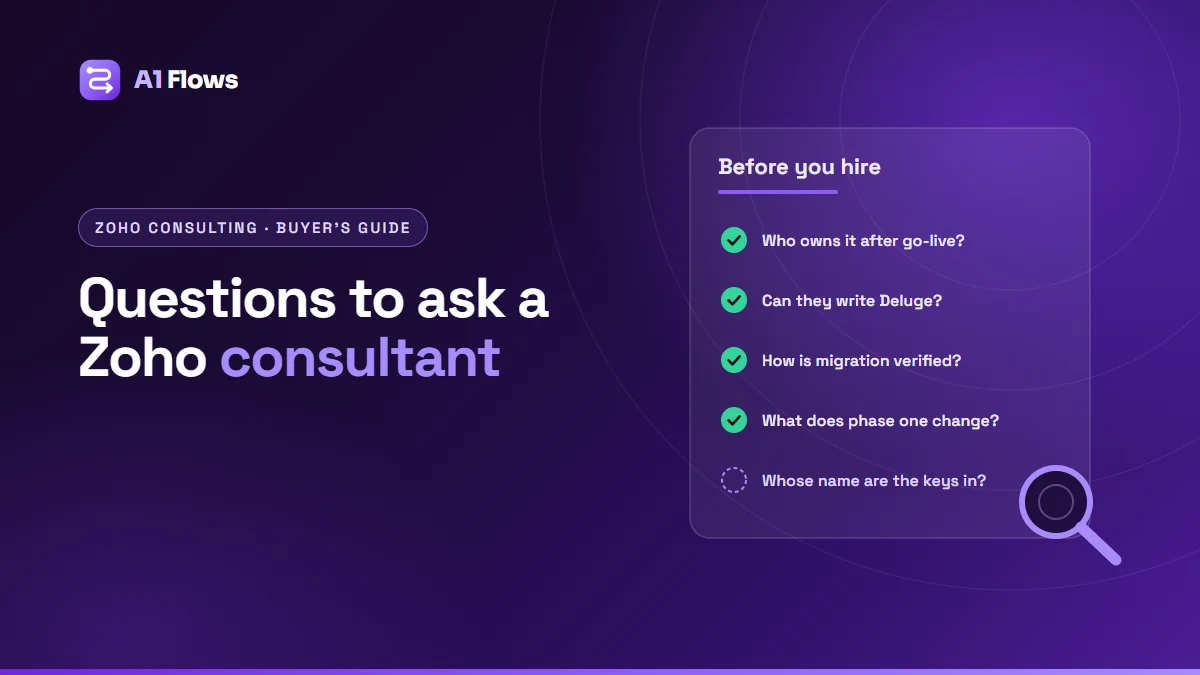
A Zoho implementation consultant designs, configures and rolls out Zoho apps around the way your business actually works. Choosing one is mostly a question of whether they will understand your process before they start configuring – and whether what they leave behind is something your team can run.
Proposals from different Zoho consultants tend to look alike. The differences show up later: in who owns the system after go-live, in whether the data migration was really checked, and in whether the automation is built in a way anyone else can maintain. This guide covers what a consultant does, when you need one, and the questions that separate the good ones from the rest.
In this guide
- What does a Zoho implementation consultant do?
- When you need a consultant, and when you don’t
- What Zoho partner tiers tell you
- 10 questions to ask before you hire
- Red flags in a proposal
- What a good engagement looks like
- Choosing a Zoho One implementation partner
- Frequently asked questions
What does a Zoho implementation consultant do?
The job has three parts, and the order matters:
- Understand the process. How a lead becomes a customer, how a customer becomes an invoice, who touches what and when, where the exceptions are. This is mostly listening, and it should involve the people who do the work, not just the people who manage it.
- Decide what Zoho should hold. Which apps, which modules, which fields, which steps are automated and which stay manual. A good consultant leaves things out as deliberately as they put them in.
- Build it. Configuration where configuration is enough, and code – Deluge, widgets, API integrations – where it is not. Then migrate the data, train the team and hand it over.
The difference between a consultant and a setup service is the first step. A setup service turns features on. A consultant starts by working out which features your business needs, and that is where most of the long-term value is.
When you need a consultant, and when you don’t
Plenty of small teams set up Zoho themselves, and for a single sales team on a simple pipeline that is often the right call. Zoho’s own onboarding material is good, and you learn the system by configuring it.
Outside help usually pays for itself when:
- More than one department will use the system. Sales, support and finance sharing records means permissions, sharing rules and handoffs – tedious to fix once people depend on them.
- You are moving from another system. Migration is where history gets lost, and very hard to redo after the team has started working in the new system.
- Your process has exceptions. If every description of how work flows starts with “usually”, the rules will need custom logic.
- Zoho has to connect to other systems. Accounting, e-commerce, telephony, an ERP. See the four ways to integrate Zoho for what that involves.
- You are adopting Zoho One. Many apps, many teams and the connections between them is where a plan matters most.
What Zoho partner tiers tell you
Zoho runs a consulting partner programme with three public tiers – Authorized, Advanced and Premium – based on criteria Zoho sets, including revenue, certifications and customer outcomes. You can read Zoho’s own description of the partner tiers.
A tier tells you a firm has a working relationship with Zoho and has met Zoho’s thresholds. It does not tell you whether that firm understands your industry, can write the code your process needs, or will still be answering the phone after go-live. Treat it as one input, not the decision. Many capable independent developers and smaller firms do excellent Zoho work; judge them on the answers to the questions below.
10 questions to ask before you hire
1. Who owns the system after go-live?
A platform nobody administers drifts back to spreadsheets within a year. Ask who holds the admin role, what happens when a field needs changing in month four, and whether that is included, billed hourly or your problem.
2. Can you write Deluge, or only configure?
Much of what makes Zoho fit a real business – cross-app automation, custom functions, API work – is code. A consultant who only configures will describe the limits of the settings screens as the limits of Zoho.
3. How will you learn our process?
Listen for workshops with the people doing the work, and for a written description of the process that you review before anything is built. Be wary of a consultant who starts by showing you a template.
4. What does phase one change for our team?
A good answer describes someone’s working day: “your reps will stop logging calls by hand” rather than “we will configure the Calls module”. If nobody can say what phase one changes, nobody knows what it is for.
5. How will you verify the data migration?
A record count is not a check. Two systems can hold the same number of records while every amount, owner and link is wrong. Ask what is reconciled – totals, relationships, dates – and who signs it off.
6. Whose name are the accounts and keys in?
API keys, OAuth connections, integration accounts and any hosting should be created under your company’s accounts. If the relationship ends, nothing should have to be handed back.
7. What will you hand over?
Expect documentation of the configuration, every automation and what triggers it, every integration’s field map, and admin access. “It’s all in the system” is not documentation.
8. Which Zoho edition do we actually need?
A consultant who recommends the cheapest edition that covers your process is looking after you. Features such as blueprints, custom modules and some automation limits differ between editions; the answer should be specific.
9. How will you train our team?
Role-based sessions beat a single long demo. What a rep does daily is a different conversation from what a manager or an admin needs.
10. What will you advise us not to do?
The best consultants talk clients out of work as often as into it. If every suggestion adds scope, ask why.
Red flags in a proposal
- A fixed price before anyone has seen your process. Either it is padded to cover the unknowns, or the unknowns will become change requests.
- Everything goes live at once. Big-bang rollouts across several teams are the ones most often abandoned.
- No mention of migration testing. It is the riskiest part of most projects.
- Credentials held by the consultant. You should never need permission to access your own systems.
- Training as an afterthought. A one-hour session at the end is not adoption.
What a good engagement looks like
- Discovery. Workshops with the people who do the work, producing a written process map you review.
- Scope. A document describing what will change, phase by phase, in plain language – and what is deliberately left out.
- Build in a sandbox. Configuration and code developed away from live data, with regular demos so you can steer early.
- Migration rehearsal. At least one trial migration, reconciled and reviewed, before the real one.
- User acceptance testing. Your team runs real scenarios before go-live, not a scripted demo.
- Go-live and support. A short, planned cutover, then close support for the first weeks while habits form.
- Handover. Documentation, admin access and credentials, all in your name.
Choosing a Zoho One implementation partner
Zoho One bundles 45+ applications under one licence, and that changes what to look for. The challenge is rarely configuring any single app – it is deciding which few apps carry your business, rolling them out in an order your teams can absorb, and connecting them so a customer entered once exists everywhere it should.
For Zoho One specifically, ask a prospective partner:
- Which apps would you start with, and why? A good answer names a small core – typically CRM plus one of Books, Desk or Projects – and explains the order.
- How will the apps share data? Directory for users, and the cross-app links between customers, invoices and tickets, should be planned before the first import.
- How do you phase a rollout? Look for phases measured in what each team can absorb, not in how fast apps can be switched on. Our Zoho One implementation checklist shows what a phased plan covers.
Frequently asked questions
How much does a Zoho implementation consultant cost?
It depends on the number of teams and apps involved, how far your process departs from Zoho’s defaults, how much data is migrating, and how many integrations are needed. Be cautious of fixed prices quoted before discovery. A good consultant will scope the first phase precisely and estimate later phases more loosely.
Do I need a certified Zoho partner?
Not necessarily. Partner tiers show a firm meets Zoho’s criteria, which is useful, but the questions in this guide tell you more about whether they will do good work for you specifically.
How long does a Zoho implementation take?
A focused CRM implementation for one team is often a matter of weeks. A multi-department Zoho One rollout is phased over months. Projects that promise everything in a weekend are the ones most likely to be abandoned.
Can a consultant fix a Zoho setup someone else built?
Yes, and it is common. A good one starts with an audit – fields, workflows, functions, integrations – and gives you an honest account of what to keep, what to rebuild and what is quietly broken, before changing anything.
Should we hire a freelancer or a firm?
Either can work. A freelancer may be ideal for a contained piece of work; a firm is usually safer for a multi-team rollout where continuity and cover matter. Whoever you choose, make sure the system is documented well enough that someone else could take over.
Can we work with a consultant in a different country?
Yes. Zoho is a cloud platform, and most implementation work is done remotely through workshops, screen-shared demos and written scope. What matters more than location is overlap in working hours for the calls that need it, and clear written communication.
What should we prepare before talking to consultants?
A short description of how work flows through your business today, the systems you use, rough data volumes, and what is not working. The better you can describe the problem, the more comparable the proposals you receive.
Making the decision
Choose the consultant who asks the most about your business before talking about Zoho, who is specific about what phase one changes, and who builds everything in your name with documentation you could hand to someone else. Those three things predict a successful project better than any tier, badge or price.
If you would like to talk through your situation, see our Zoho One consulting and implementation and Zoho CRM implementation services, or book a free call and ask us these same ten questions.